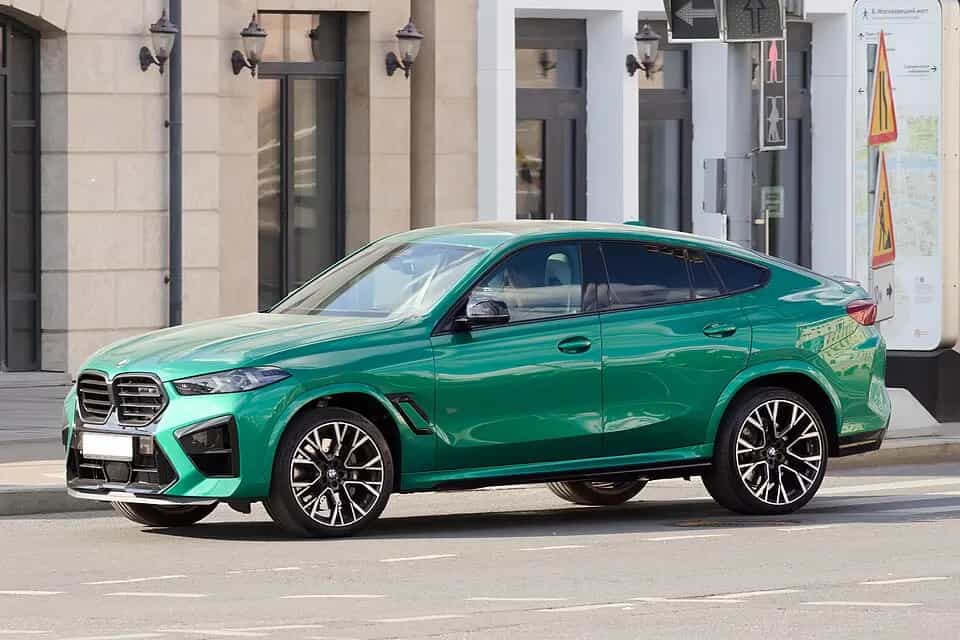
BMW X6 M

Importing a used BMW X6 M from the USA

The X6 M is the extreme end of BMW's Sports Activity Coupe idea: a coupe-profile SUV with a twin-turbo V8 and full M engineering. It is one of the more compelling US imports because BMW builds the X6 in South Carolina, meaning America is effectively the home market for these cars — the used pool is deep, well specified, and often better optioned than European equivalents. For a German buyer chasing a specific colour, spec or model year at the right condition, sourcing a used X6 M from the USA frequently beats waiting for a domestic car. USCar Trader operates strictly as an independent broker, arranging individual used vehicles rather than holding stock.

BMW x6-m – used car imported from the USA
Photo: Retired electrician · CC0 · Wikimedia Commons

Model history and generations

Three generations define the X6 M. The first (E71, 2010–2014) introduced the concept and paired the body with the S63 twin-turbo V8. The second (F86, 2015–2019) refined the chassis and adopted an eight-speed automatic with more power and better efficiency. The third (F96, 2020 onward, based on the G06 X6) pushed output higher still, added a 48-volt mild-hybrid layer on later cars, and split into standard and Competition specifications. Each generation shares the theme — brutal straight-line pace with a surprisingly composed chassis for its mass.

Engines and drivetrain

Every X6 M uses a version of the 4.4-litre S63 twin-turbo V8 with the hot-vee turbocharger layout. The E71 produced roughly 555 hp through a 6-speed automatic in early cars; the F86 raised that to about 567 hp with the ZF 8-speed; the F96 delivers around 600 hp, or roughly 617 hp in Competition form. All run BMW's M-tuned xDrive all-wheel drive with a rear bias, and all are torque monsters — well over 700 Nm. The result is 0–100 km/h times that started near 4.7 seconds and dropped comfortably under 4 seconds on the latest cars, remarkable for a two-tonne-plus SUV.

Which trim makes sense

The body is always the four-door coupe-SUV; there is no wagon or long-wheelbase X6 M. The main split is standard versus Competition on the F96, the latter adding power, model-specific styling and chassis tweaks. US cars are typically loaded with the Executive package, Bang & Olufsen or Harman Kardon audio, carbon or aluminium trim, merino leather and large wheels. Carbon-ceramic brakes were an option worth seeking on harder-driven examples.

Supply on the US market

Because the X6 M is built in Spartanburg, the American market has strong supply across all three generations, often with high-spec configurations. Typical used cars range from early E71s with meaningful mileage to nearly-new F96s coming off lease. Warm-state cars avoid salt and are the pick for underbody condition. Given the performance, buy on documented maintenance rather than headline mileage — a fastidiously serviced higher-mileage car beats a neglected low-mileage one every time.

Who benefits from importing

This is for the buyer who wants supercar-baiting acceleration with four proper seats, all-wheel-drive traction and a large boot — a genuine do-everything performance car. It suits enthusiasts targeting a particular generation or Competition spec that is scarce in Germany, and who understand that running costs are firmly in the high-performance bracket. If you want the drama of an M V8 in a usable body, the X6 M delivers.

Technical data

Body style4-door coupe-SUV (Sports Activity Coupe)
GenerationsE71 (2010–2014); F86 (2015–2019); F96 (2020–)
Engine4.4 L S63 twin-turbo V8
Power (E71)approx. 555 hp
Power (F86)approx. 567 hp
Power (F96 / Competition)approx. 600 / 617 hp
Torqueapprox. 680–750 Nm
Transmission6-speed auto (early E71); ZF 8-speed auto
DrivetrainM xDrive all-wheel drive (rear-biased)
0–100 km/happrox. 4.7 s (E71) to under 4.0 s (F96)
Top speedapprox. 250–290 km/h (limited)
Length (F96)approx. 4.94 m
Curb weightapprox. 2,300–2,400 kg
Fuel tankapprox. 83 L
Seating5
BrakesM compound; optional carbon-ceramic

Known weak points and maintenance

X6 M reliability centres on the S63 engine, which is powerful but demanding. Known X6 M common problems include timing-chain and guide wear on higher-mileage early units, VANOS solenoid faults, ignition coils and injectors, and turbocharger oil-feed and coolant lines that can weep. Oil consumption is normal to a degree, so consistent oil-level discipline and on-time changes matter enormously; a car with documented short-interval servicing is worth a premium. The 8-speed ZF automatic is generally robust but benefits from fluid changes the factory calls lifelong. Brakes and tyres are consumables that wear fast under enthusiastic use, and on air-sprung or adaptive-damper cars check the suspension for leaks and fault codes. In short, these are not cars to run on a shoestring — buy the best history, not the cheapest price.

US and EU spec compared

US cars use amber-integrated rear indicators, DOT headlights, an mph-primary cluster and usually no rear fog lamp. Infotainment and navigation may be US-region and can need a European map/coding update. The drivetrain is mechanically identical to the European car, so there are no engine-specific hurdles — the work is lighting, minor coding and documentation.

The import process in detail

Select a documented car and arrange a pre-purchase inspection given the value at stake; decode the VIN and confirm the Spartanburg build for the customs position; use escrow to secure the funds; ship by container (recommended for a car of this value) from a US port to Bremerhaven; clear German customs; present for TÜV and individual approval (§21 StVZO Einzelabnahme); then register. A specialist BMW inspection before purchase is strongly advised.

What customs clearance really costs

Bottom line: what matters is the factory shown by the VIN – proven US origin unlocks 0% duty. The 19% import VAT always applies.

Duty and VAT are always separated. The 0% import duty under Regulations (EU) 2026/1455 and 2026/1461 (in force since 1 July 2026, direct transport, valid to 31 December 2029) applies only where US origin is provable via the VIN and plant. The X6 M is manufactured in the USA (Spartanburg, South Carolina), so a US-origin car can qualify for 0% — but this is confirmed per VIN, never guaranteed in advance. Regardless of origin, the 19% German import VAT (Einfuhrumsatzsteuer) always applies to the customs value plus freight. We never advertise duty-free status and add no margin to the vehicle.

TÜV, modifications and registration

Typical items are adding or converting a rear fog lamp, adapting the rear indicators, ensuring headlights are suitable for right-hand traffic, and confirming a km/h speedometer (usually present as a scale or switchable display). The odometer reading is documented and carried across. Any aftermarket tune or non-standard exhaust must be declared and approved, or reverted to stock for approval.

Check before you buy

1) Decode the VIN and confirm the Spartanburg plant for the customs rate. 2) Pull a Carfax or AutoCheck history for accidents, title brands and odometer integrity. 3) Commission a specialist inspection focused on the S63 (oil leaks, turbos, timing). 4) Review complete service records and oil-change intervals. 5) Check brakes, tyres and suspension for wear and leaks. 6) Confirm the title is clean unless a salvage car is a knowing choice. 7) Scan for stored fault codes and verify no undisclosed tune.

Common questions

Is the X6 M built in America?

Yes — every X6 M is produced at BMW's Spartanburg, South Carolina plant, which is why US supply is so strong.

Can an imported X6 M get 0% duty?

It can, because it is US-built, but only when US origin is proven through the VIN and plant. The 19% import VAT still applies.

Which generation should I import?

The F86 balances performance and value; the F96 is the most capable and modern; the E71 is the cheapest entry but needs the most careful history check.

How reliable is the S63 engine?

Strong when maintained strictly, but sensitive to oil discipline and prone to turbo and timing wear if neglected — documented servicing is essential.

Are running costs high?

Yes — fuel, tyres, brakes and servicing are all in the high-performance bracket, so budget accordingly.

Do I need carbon-ceramic brakes?

Not essential, but they are a desirable option on hard-driven cars; verify their remaining condition, as replacement is expensive.

Will it pass TÜV?

Yes, with the usual lighting adaptations and an individual approval, provided any modifications are declared or reverted.

How long does the import take?

Typically several weeks from US port to German registration, driven by freight and customs timing.

Discover more in the BMW in the Carhub, compare it with the BMW X5 M, the BMW X3 M and the BMW X4, or browse the current X6 M listings.